Thursday, June 5, 2014

Steady in Jerks


This storm ended a pretty good run in the month of May.  The month had started out slow, with nearly six inches of rain the first two weeks.  Soon enough things began to dry out and it was time to go to work.  I finally started planting corn on the 20th of May.  Last year I was done planting corn on the 14th of May for comparison.  Although the two years have started off a little different, they are beginning to look very similar.  We went right from corn into milo, and after a few hiccups the milo planting was finished Thursday evening the 29th.  Last year, I didn't get an acre of milo planted until June 5th, so we are ahead of the game so to speak. After some spraying and an attempt to finish some discing to knock out some ruts from last year's harvest, the streak of dry weather ran out.  It rained Friday night, and then off and on for the rest of the weekend.  I dumped out 2.40" of rain from the gauge near the preserve.  We had another rain day on Tuesday and then caught a pretty good shower last night again.  I'm sure we're sitting somewhere near 3.5-4 inches of precipitation depending on the location since the weekend.  We've got food plots and sunflowers left to plant, the good news is, the cover looks great, and the hens have been busy nesting and should begin hatching chicks within the next week or so. 


Although I've been busy running from tractor to tractor and swapping out the planter for the sprayer, I have had a chance to snap a few pics while being out and about.  I found this badger one morning as I headed to the planter.  I think she may have a couple young ones in this den because she's kept it pretty cleaned out, and been there for several days.  I've caught her out and about a couple times going to and from the field, but she seems fairly undisturbed unless you get too close.  A few growls and hissing was enough to send me back to my pickup after peeking into the hole.

 I happened to come across this nest as I jumped out of the tractor to check on my sprayer.  I noticed a hen sneaking away only a few feet from me, and then found the nest tucked into the laid over vegetation.  There are 13 pheasant eggs and a duck egg.  Once it dries out enough and I can get back down to where I found this I will see how she's doing.  The hen didn't go far and as soon as I moved my equipment she made her way back to the nest.  Speaking of ducks, I happened to come across two nests of theirs while planting and spraying also.  There are plenty in the country and the weather that we've had the past couple of weeks has been excellent for nesting, producing cover, and raising lots of bugs for those chicks to eat once they hatch.  We should begin to see chicks soon, but will have a better idea of how things are shaping as we near the end of June.

Cordie has finished pouring "spring" bins and is moving onto other projects.  Things will remain busy the next month or so, and then we should be able to find a little down time in July before we gear up again and begin preparing for the fall.  Hope everything is going well for all of you.  Take care.


Monday, April 28, 2014

Spring Happenings

We're finally getting our first shot of spring moisture in the form of a good soaking rain.  It started Sunday evening, and has continued throughout the day today.  Locally, I've heard of reports from 1.5 to 2.5 inches so far.  It sounds like it should continue tomorrow, and a few more chances are forecasted throughout the week.  The moisture was needed, and hopefully some warm temperatures will follow to get the crops and grass growing for some excellent pheasant habitat.

The birds are in full swing in their nesting season, but plenty of time remains for them to get after it and for young chicks to hatch.  The month of May is a critical time for the birds and June will  soon follow as chicks begin to show up, as long as Mother Nature cooperates.  Things look good so far.

We've been getting a few other outdoor activities in, as we tested out the fish ponds last weekend.  The bass seemed to be in pretty good shape, and Marlys showed us all up by catching the largest fish of the day-a good healthy 16.5 inch bass.

The perch pond was not as active, but the signs of life were there with numerous egg masses spotted hanging from submerged vegetation.  We'll continue to test the waters and keep you updated.

In other happenings around Presho, there was a fire in one of the large grain bins at the elevator near the lodge.  One of the bins, holding nearly 190,000 bushel of milo began smoldering last weekend.  As smoke billowed out the top, the fire department was called and a plan was made.  The elevator has been continuously drying grain since harvest this past fall, with grain constantly being hauled in and out.  They soon began spilling the grain out the side of the grain bin to find the smoldering grain.  This continued for several hours as the County helped by pushing grain into a pile as it poured out and the firefighters sprayed it down to eliminate any hotspots.  Approximately 70,000 bushel was dumped on the ground before they figured they had removed all of the burning grain.  The milo will most likely be sold at a reduced price for cattle feed.    


Tuesday, March 4, 2014

They're Alive!!

It's been a somewhat long and drawn-out winter, but the pheasants seem to be holding up just fine.  We've come out of another polar vortex and as the temperatures climbed above zero this morning, I ventured out to see how our feathered friends were getting along.  Finding birds has been real hit or miss in the last couple of months.  Cordie and I have ventured out in the past and had trouble finding any sign of the birds.  We really haven't received a ton of snow, but enough to keep the ground white.  The temperatures have been the rough part, with many days below zero, and long stretches of cold, windy weather.  We've been hoping the birds are hanging in there.  Our theory has been that with the amount of food and cover that was available this year, that the birds should have entered the winter in the best shape that we could hope for.

It is March and we're not out of the woods yet, but things should begin to turn around here.  It was good to see as I pulled into one of the properties this morning that I could see the birds scrambling about in and amongst the trees.  Many birds of prey had the birds utilizing some dense brushy cover as they waited for any number of them to make a mistake and leave their protection.  The birds weren't in any hurry to bound into the open, but eventually began frantically scurrying and flying about.  Lots of hens and just enough roosters to hopefully provide for a successful hatch this spring.


Many birds stayed tucked in as I began to drive between the rows.  Some even held underneath the cedars and russian olives until I drove past.  The rooster below had no intentions of leaving his hidey-hole.


Like I said, we've got  a ways to go yet, but things look good so far.  It won't be long now, and March will be going out like a lamb, and April rain showers will cleanse the ground of any sign of winter.  As things begin to green-up, those hens will be dispersing and picking their nesting spots.  Soon enough we'll be whining about how hot it is, and looking for chicks and wishing it was October again.  Soon enough.

Friday, February 21, 2014

End of Year Wrap-up!!

Yes, I know it's been a while, but I've been busy (for the most part).  I'll try to continue to update everyone on a few things as they happen, but I thought I would do a little recap on how the year went.  With the introduction of our deer hunts, I thought I would start there.  We had a successful year, with five clients with buck tags, and all of them filled.  Below are a few of those pictures along with those of us at the Lodge that filled our tags.  Abby killed her first deer, which was a nice 4 x 4.  Cordie was able to fill his tag with Kellen in the blind next to him, and both Brandon and I took nice deer off of some ground that we pheasant hunt from.  The two racks that you see on the tailgate are what were left of the deer from two of our clients after they had taken them to the taxidermist to be caped.  Very respectable deer, with most in the 130-150 inch class.  We'll continue to work towards improvement on this end of the business, and expect the deer numbers to hold steady or increase due to mild weather conditions and habitat improvement in our area.

We did have a very good year, even though it started out a little rough.  It did finally quit raining and harvest was eventually completed and it led to some pretty decent hunting.  The pheasants should be in good shape entering the spring, but we have plenty of time for a disastrous storm.  We'll keep our fingers crossed and hope for the best for a good spring hatch.

I hope everyone is staying sane and healthy with the wacky winter weather that has bombarded parts of the country that are not used to it.  We're wishing you well and hope to see everyone for a happy return in the fall of 2014.  I'll do my best to keep everyone updated on the happenings at the Snake Den.


Thursday, September 5, 2013

Down but Not Out


Maybe you've heard that the SD Game, Fish & Parks annual brood survey showed a 64% decrease in bird numbers compared to last year, and a 76% decrease from the 10-year average.  I know that sounds horrible, but I believe there are several bright spots to this years upcoming hunting season.  You can read the full report here.  Within this report the State lost nearly 50% of the hens they had collared between last years brood survey, which is conducted in August, and November.  If you recall the extreme drought that we experienced last year, we felt as though we were in decent shape according to last years numbers and what we were seeing early on.  As the drought continued it had detrimental affects, not only on chicks, but apparently also on adult birds.  

This year has been a completely different story.  After a fairly mild winter, we began to receive significant snow fall in April when birds normally begin to nest.  The moisture was welcome, but set back the birds nearly a month in their nesting activity.  After the April snow, conditions remained fairly cool, and dry.  Significant moisture did not return until sometime in mid-May, and then again June, July and even August.  The cover that the birds depend on to nest in and later raise their chicks in had been severely hampered by last years drought, and did not recover until sometime near the end of May or even June.  We received nearly 5 inches of rain in both July and August, when the average is near 2.5 inches per month.  Some of our property received nearly 12 inches of rain from July 15-August 15.  This has been great for the food plots, row crop, and CRP cover.  The cool temperatures that we experienced in July did hamper some row crop development, but things have returned to normal, if there is such a thing, since the 90-100 degree temps we have experienced in the past couple of weeks.


Soooo..... what am I getting at?  What are the bright spots??  I think we will see the opposite results of last years brood route surveys.  We've seen more birds appearing in the past couple of weeks then we have all summer long.  With nesting so far behind and the cover in such good shape, there just weren't many birds near the roads or visible for the annual counts.  Nearly 90% of the winter wheat crop was removed and planted to row crop this year, which makes for a lot of milo, corn, and sunflowers for the birds to hide in.  There is water everywhere, so the birds are not congregated around limited water sources.  This by no means is going to be a run-away year, but I do believe it will be as good as last year, if not slightly better.  There is going to be a lot of crop in when we start beating the bush, so birds may be hard to find to begin with, but things should improve as the season progresses.


A few other things also.  We've added some great property to our arsenal, which are a few of the pictures that you see posted here.  It's going to be some interesting hunting, as we figure out how things work on this new property, but it has a lot of good CRP and undisturbed habitat, and a steady water source.  It's got  a ton of potential and will only get better as we figure out it's secrets and continue to develop it as we have everything else.  We look forward to another year, and can't wait to get into the field with all of you.

Monday, July 8, 2013

Snake Den family loses a good one

Isburg Funeral Chapels: Obituaries
John Jund Jr.
(October 10, 1945 - July 5, 2013)
John Jund Jr.
U.S. Veteran


John Jund, 67 of Pierre, died Friday, July 5 at Avera McKennen
 Hospital in Sioux Falls. Visitation will be 5-7pm, Monday, July 8
 at Ss. Peter & Paul Catholic Church in Pierre with a Prayer Service
 at 7:00pm, Monday at the Church. Services will be 10:00am,
Tuesday, July 9 at Ss. Peter & Paul Catholic Church with burial
 at Calvary Cemetery in Pierre   
John was born October 10, 1945 to John and Rose (Salwei) Jund
 in Zeeland, ND. He moved with his family to Mobridge in 1960
 graduating from Mobridge High School in 1963.
In April of 1964 he started working for the State of South Dakota
 where he worked until his retirement in January of 2003.
 On January 29, 1966 John was united in marriage to Carla Schlomer,
 to this union two children were born: John Wayne and Lori. He
was a member of the South Dakota National Guards retiring in 1985.
Since his retirement he spent his time doing the things he loved
the most: hunting, gardening and spending time with his grandkids.
He always planted a garden large enough to feed a small community.
John spent many hours weeding and watering and he took great
pride in hand delivering his goods to anyone who would enjoy 
them.   
Hunting has always been a very important part of his life and
something he spent a great deal of his time doing. He also
greatly enjoyed his years of guiding at the Snake Den Lodge.
It allowed him to make lasting friendships while spending
time doing what he loved most. He loved time with his grandkids
 whether it was mowing, playing dominoes or just watching them
 in the back yard.
He is survived by his wife Carla, Pierre; children: John Wayne,
and special friend, Shelly Wanner, Pierre and Lori (Brad)Klemann,
Pierre; five grandchildren: Dalton Grassel, Brevin Klemann,
Braya Klemann, Kindra Jund and Carter John Klemann;
 siblings: Francis (Carol) Jund, Mobridge, Joe (Eleanor) Jund,
 Aberdeen, Mike (Sharon) Jund, Davenport, IA,
Mary (James) Holzer, Stevens Point, WI, Eva (Darrold) Fischer,
 Rapid City, Caroline (Mike) Jackson, Broomfield, CO and
Sally (Daryl) Isburg, Ft. Pierre;
 sister-in-law Maureen Jund, Rapid City, uncle Joe Salwei,
Bismarck, ND and numerous nieces, nephews and cousins.
He was preceded in death by his parents, John and Rose Jund and
one brother, Gerald Jund.

Back

Friday, March 15, 2013

Once was... is not.

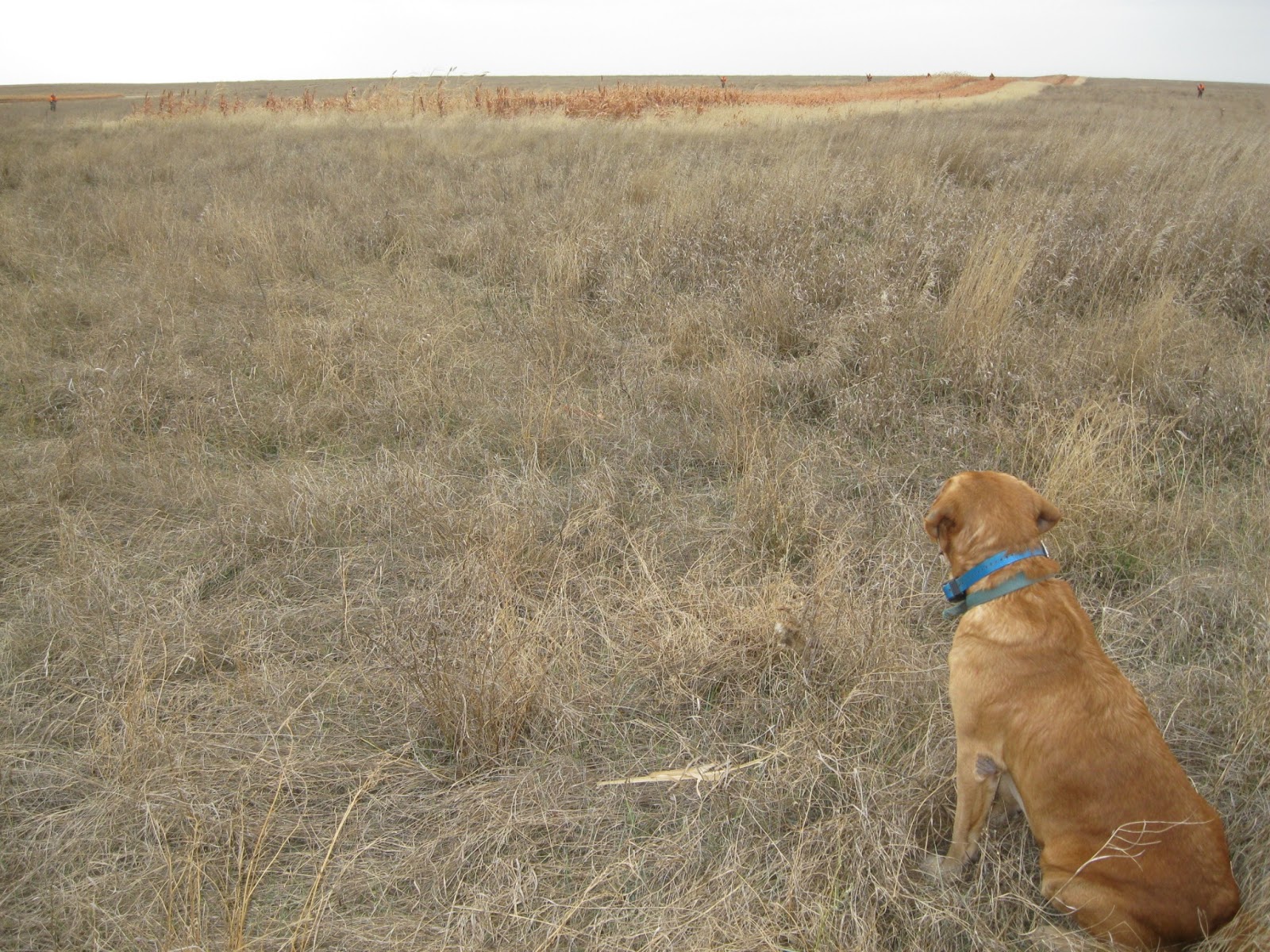
"Copper" waits patiently at the end of a food plot in a CRP field.

The scene pictured above, will take on a drastically different look in the fall of 2013.  No... it's not that "Copper" will be older and fatter.  Although that may be the case, as with most of us, the CRP field where this picture was taken has fallen to the plow and will be farmed this spring along with 9.7 million acres that have been released from the CRP program since 2007.  With the increase in grain prices and land prices, CRP has failed to keep up with support and demanding values.  Although we are currently playing both sides of the fence, where we will see it affect us the most is definitely in our hunting.  The Snake Den will lose approximately 960 acres of CRP ground in 2013.  Luckily we have teamed up with another landowner, who is very pro-active in enrolling his ground in the program, and should combat the loss with the addition of another couple thousand acres.  In the scheme of things though, it's a drop in the bucket.   South Dakota lost nearly 168,000 acres of CRP in the last year, Lyman County nearly 20,000.  CRP provides vital nesting and brood-rearing ground needed for hen and chick survival.    

Attached is a snippet of the newsletter that I receive from Pheasants Forever.  There are a ton of stats contained within the article, but the bottom line is this: as CRP acres decline, so do pheasant numbers.  You can also see the correlation provided here by SD Game, Fish and Parks.  We can only hope that congress and landowners alike can see the value in CRP, along with pheasants and other wildlife.


USDA Secretary Delivers Welcome CRP News to Pheasants, Quail and Hunters
CRP General Sign-up announced along with opening continuous CRP
Minneapolis, Minn. - February 16 -
Pheasants Forever (PF) and Quail Forever (QF) were pleased to be joined today by U.S. Secretary of Agriculture Tom Vilsack during its sold out 30th anniversary banquet in Minneapolis. During his keynote address at the event, Secretary Vilsack announced much needed conservation tools to the attendees. The audience for the announcement included U.S. Senator Amy Klobuchar, U.S. Senator Al Franken, U.S. Representative Collin Peterson, and more than 1,000 Pheasants Forever and Quail Forever members.
The Secretary outlined three major USDA conservation measures for Ameri-ca’s farmers and ranchers. First, a new 4-week Conservation Reserve Pro-gram (CRP) General Sign-up is scheduled to start May 20th and will provide landowners with a competitive opportunity to enroll their toughest-to-farm, environmentally sensitive acres in CRP for the benefit of wildlife, water qual-ity and soils. The last general signup occurred during the spring of 2012, in which nearly 4.5 million acres were offered and 3.9 million of those acres were enrolled in the program.
Second, Secretary Vilsack announced there will be a review of soil rental rates in an effort to keep CRP competitive with current near-record commodity-driven land prices. And third, Secretary Vilsack announced plans to reopen enrollment for Continuous CRP acreage made possible by the extension of the 2008 Farm Bill through 2013. The reopening of Con-tinuous CRP makes available 1 million acres reallocated in 2012 to some of CRP’s most targeted and effective practic-es, like CP38 SAFE and CP33 Buffers.
“Under President Obama’s leadership, USDA has worked with a record number of farmers, ranchers and landowners – more than 500,000 across the nation – to achieve record benefits in soil and water conservation,” said Secretary Vilsack. “By ensuring that CRP remains strong, vibrant and an economically viable option for producers, we can ensure impactful conservation efforts in the years to come – including healthy wildlife habitat in every corner of our nation.”
“We absolutely needed these tools to be delivered now. Considering the massive habitat losses experienced as a result of last summer’s drought and the fact producers are planning their spring plantings right now, this was a critical announcement for farmers, hunters and conservationists,” says Dave Nomsen, Pheasants Forever’s vice-president of governmental affairs. “Of particular importance today was mention of the soil rental rates review. Improving CRP’s financial viability is critical to making this program successful for our farmer friends.”
The Conservation Reserve Program is a voluntary program designed to help farmers, ranchers and other agricultural producers protect their environmentally sensitive land. Through CRP, eligible landowners receive annual rental payments and cost-share assistance to establish long-term, resource conserving covers on eligible farmland. Land can be enrolled on a continuous basis for a period of 10 years. Land currently not enrolled in CRP may be offered in this sign-up provided all eligibility requirements are met.
Landowners interested in learning more about the upcoming general signup, review of soil rental rates or the continuous CRP acres available, are asked to contact a Pheasants Forever Farm Bill wildlife biologist. For additional inquiries, please contact Dave Nomsen, Pheasants Forever vice-president of governmental affairs at (320) 834-3076 or email Dave.
Pheasants Forever, including its quail conservation division, Quail Forever, is the nation's largest nonprofit organization dedicated to upland habitat conservation. Pheasants Forever and Quail Forever have more than 135,000 members and 720 local chapters across the United States and Canada. Chapters are empowered to determine how 100 percent of their locally raised conservation funds are spent, the only national conservation organization that operates through this truly grassroots structure.

Secretary Vilsack Announced Welcome CRP News
Is Anyone Paying Attention? We’ve Lost 9.7
Million Acres of CRP Land in Five Years.
The amount of land enrolled in the Conservation Reserve Program (CRP), at 27.1 million acres, is down by 26 percent, or 9.7 million acres in the past five years, to a 25 year low. During this same time period, corn acreage has increased by 13 million acres. Farmers are once again planting crops on marginal lands “fencerow to fencerow” to cash in on today’s high commodity prices. CRP payments haven’t risen to compete with crop returns, and the program itself is being whittled away by Congress.
The Conservation Reserve Program exists to provide land owners with some financial incentive to idle their land, which in turn benefits the environment while providing commodity price sup-port by reducing surplus production. But now, ethanol policy makes that curb of surplus production unnecessary. The original CRP legislation, the Food Security Act of 1985, set a goal of enrolling over 40 million acres into the program by 1990 but that has never been reached and is now falling sharply. The laws regulating the program have been tweaked many times since begun in 1985, being tugged and pulled by various special interests. Prior to the CRP, we had “set aside acres” in the 1970′s and “soil bank” acres in the 1960′s.
If you visit one of the USDA’s websites promoting the benefits of the Conservation Reserve Program, you will see a long list including the following:
• Reduces soil erosion by an estimated 450 million tons per year, compared with pre-CRP erosion rates.
• Protects surface waters from sediment and nutrient enrichment with enrollment of 1.8 million acres of streamside grass and forested buffers.
• In prime pheasant habitat, a 4 percent increase in CRP grassland acres was associated with a 22 percent increase in pheasant counts.
By K. McDonald on March 7th, 2013
• Sequesters 50 million metric tons of carbon dioxide annually in soils and vegetation on enrolled lands.
• Includes 8.3 million acres enrolled in the Prairie Pothole region providing habitat important for migratory waterfowl, grassland birds, and dependent species.
There’s nothing not to like in that list. CRP policy is an environmentally friendly one which helps protect this nation’s privately owned natural resources of soil and water. It adds to biodiversity and wildlife habitat. The program is especially appreciated by older farmers. On the down side, nearly half of CRP funds go to the top ten percent of recipients, according to the Environmental Working Group. And, some politicians argue that we shouldn’t pay farmers not to farm where they shouldn’t be farming in the first place.
Today, the economic incentive to grow corn, even on marginal lands, far exceeds the average amount of $57 paid per acre by the CRP program. Keep in mind that most of the acres enrolled in CRP have always been the marginal lands, those which are less productive, and are more vulnerable to erosion. In addition, budgetary pressures in writing a new farm bill make this program an easy target. At this year’s current enrollment the CRP costs the taxpayer around $1.6 billion, down from 2 billion a few years ago.
The map below shows us that 2.5 Million Acres of Conservation Reserve Program (CRP) land was lost in just one year in the con-tracts held in 2011 versus 2012. Much of the area exiting the program this past year was in the Plains states to grow more corn on marginal land. The two states converting the most CRP land to crops this year are North Dakota and Montana, in part due to in-roads of corn and soybean acres into this traditionally wheat growing region. After these two states, Minnesota, Missouri, and Kansas top the list of recent CRP lands lost for crop conversion.
Agribusinesses are reaping fat financial rewards from the price incentive to plant a record 97 million acres in corn, including on what was formerly CRP land. Further land use changes are also resulting from the ripple effect that high corn prices have on all of the commodities, not only in the U.S. but around the globe. High prices are appreciated by producers, but current Ag policy of intensive, industrial, all out agricultural production isn’t free and it isn’t sustainable. Unfortunately, environmental interests can’t compete politically with policies that promote the increased use of fertilizers, pesticides, seeds, commodity exchange, and equip-ment sales.
This next graph shows us the loss of CRP land since 2007 in the top four corn producing states.
Farmers, who are always at the mercy of policy which determines their economic survival, are being told today that they are being patriotic and helping with national security and energy independence by growing corn for ethanol. A truly patriotic policy would instead be the preservation of our nation’s soil and water for future generations.
This story wouldn’t be complete without pointing out the sharp contrast in priorities of land conservation between the top agricultural leaders of the E.U. and the U.S.
The European Union’s agricultural commissioner, Dacian Cioloş, saw the destruction that all out production did to the soils in his home country of Romania under the former communist regime, so he wants to see 7 percent of E.U. farmland turned into environ-mental priority areas which are off-limits to the use of chemicals and high-tech farming methods. He also knows that 90 percent of Europeans want to see policies which promote the public good in return for their taxpayer money spent on agriculture. He was trained as a horticultural engineer and spent thirteen months over a number of years doing organic farm internships in Brittany France. He was selected to lead the E.U. in agriculture because of his horticultural experience and education, and for his “modern vision” for agriculture. He wants an E.U. agricultural policy that discourages monocultures, encourages rotational farming methods, and decreases fertilizer use.
In contrast, our U.S. Secretary of Agriculture, Tom Vilsack, is a lawyer and a politician, a former governor of Iowa.
If allowed a say on the issue, Americans, too, might strongly support CRP initiatives over today’s other farm programs which are far more expensive: direct payments, tax payer subsidized crop insurance, and biofuels incentives.
But, CRP support in Congress is fading. In the 2008 farm bill, it took a hit of 7 million fewer acres, and in the 2012 farm bill the plan is to cut another 7 million acres and to cap the program at a total of 25 million acres by 2017. That’s a far cry from the original 40 million acres planned in the 1985 legislation. A total of $6 billion in conservation cuts is expected in the next farm bill. In the congressional fiasco that occurred at 2012′s year-end, the old farm bill was extended through September 2013, when a new bill cover-ing the next five years should have been passed and would now be in place.
The story and statistics that I’ve presented above aren’t widely-known. Americans need to contact their policy-makers to let them know what is important to them. The Conservation Reserve Program and agricultural conservation support is in trouble and needs our help.